

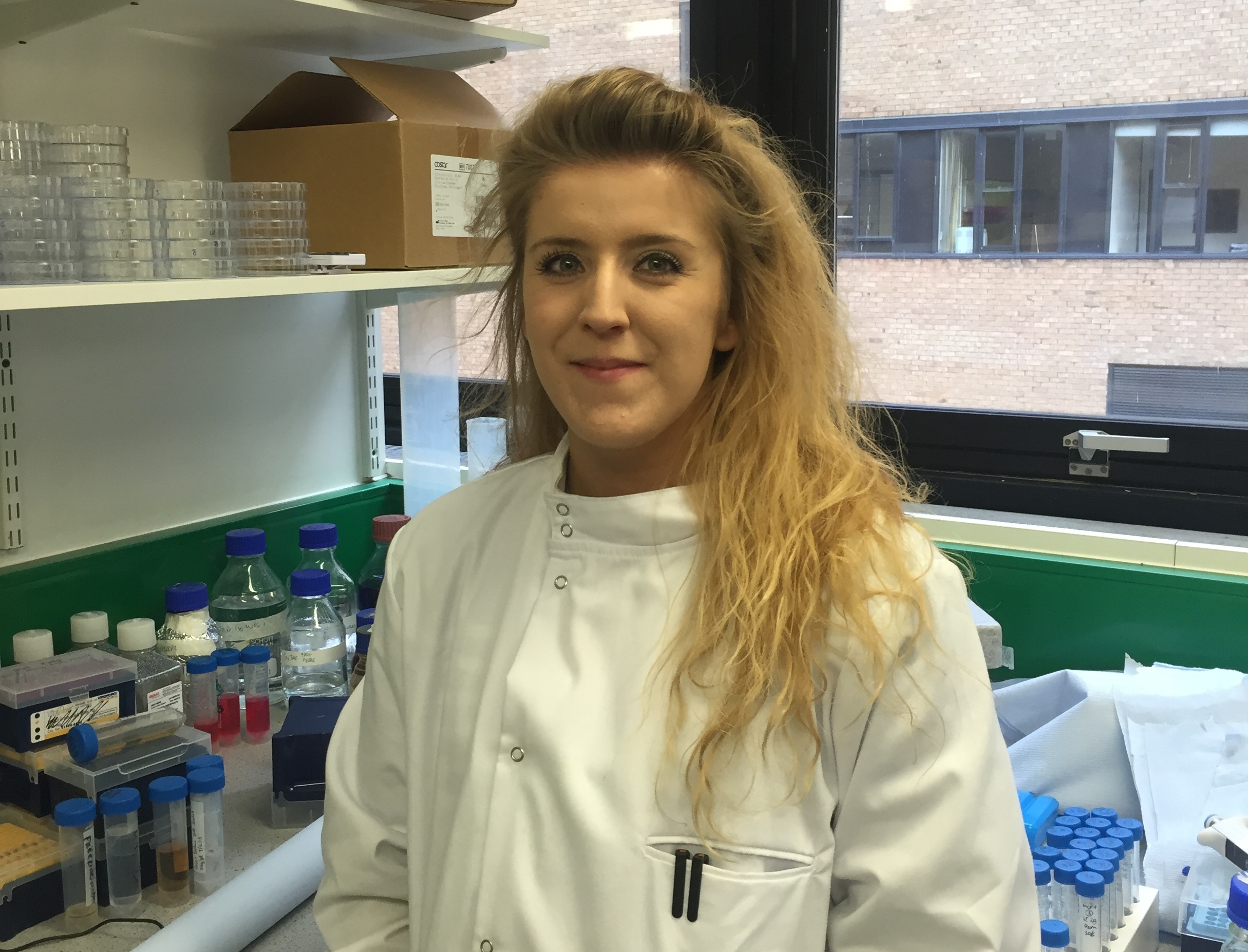
A PhD student who is being supported through the Armitage Thanks partnership is making important progress in her research into treatments for bowel cancer.
Hannah Bolland, who is studying at Nottingham University under the supervision of Professor Alan McIntyre, is looking at the behaviour of bowel cancer when the oxygen supply is low.
This is an important feature of how aggressive bowel cancer is and what the patient’s prognosis is because when cancer develops in areas of low oxygen it becomes harder to treat.
A key reason for this is that the blood vessels in the tumour form in a distorted way and it is difficult for chemotherapy to reach all the areas that it needs to.
About one third of bowel cancer has this characteristic and there are currently no treatments specific to low oxygen bowel cancer.
Hannah is now in year two of her PhD and has identified a single protein that is key to enabling bowel cancer cells to survive in low oxygen conditions.
She has also tested this in 3D structures called Spheroids. This protein is now a viable target for the development of therapies.
Deborah Gilbert, Chief Executive of Bowel & Cancer Research, which is funding Hannah’s work through an Armitage Thanks donation, said: “Over the next year Hannah will move on to look at what mechanisms the protein uses to enable the cancer cells to survive in order to develop better diagnostics and treatments.
“If current progress continues the work will enable us to find out whether a patient’s cancer has low oxygen characteristics and therefore ensure that they receive early and appropriate treatment.
“It will also translate into the development of new therapies that can treat these cancers in a way that can’t be done with current chemotherapy.”