


For more than four decades, Liam Ansell and Andy Warrington have been part of the story of Armitage Shanks, then Ideal Standard and now Villeroy & Boch. From joining as teenagers on the Youth Training Scheme to witnessing huge changes in technology, manufacturing and workplace culture, they have seen the business transform beyond recognition. We talked to colleagues Liam and Andy to look back at the people, memories and moments that have shaped their careers.
When Liam Ansell and Andy Warrington joined Armitage Shanks in the 1980s, the workplace looked very different.
There were no smartphones, no emails and no instant access to information. Customer orders were processed on paper, price lists were created manually and internal communication could take days.
Today, more than 40 years later, both remain an important part of the business as Key Account Managers at Villeroy & Boch, having built careers through a period of enormous change.
But while the technology and processes have evolved, one thing has remained constant: the people.
Andy (left) and Liam (right) with Bob Baseley, who still works in the Armitage plant.
A connection that started early
For both Liam and Andy, Armitage Shanks was part of their lives long before they officially joined the company.
Liam moved to Armitage from Paisley, Scotland, in 1972 at the age of three, with his parents and older sister Sarah. His parents had bought a grocery shop on New Road in the village, and with Armitage Shanks employees regularly visiting the shop, the company quickly became a familiar part of everyday life.
After leaving school in July 1985, Liam applied for the Armitage Shanks Youth Training Scheme (YTS), earning £25 a week while gaining experience across different departments including HR, Accounts, Export, Transport and Production Planning.
A permanent opportunity followed, and Liam officially joined the business on 6 May 1986.
Andy’s connection with the company was equally strong. Growing up in nearby Handsacre, his parents John and Sue Warrington both worked in the Armitage Shanks warehouse, with his father spending his entire working life at the company before retiring in 1998.
After a meeting with a careers officer at school, Andy was encouraged to apply for Armitage Shanks.
“I remember speaking to friends who had also had similar meetings and it seemed the careers officer had recommended Armitage Shanks to everybody, even if they told him they wanted to be an astronaut!”
Andy joined the YTS scheme in 1984, gaining experience across different areas of the business before moving into the pricing department. His first full-time role came with a salary of £2,700 a year, doubling his YTS wage to £50 a week.
“It was enough at the time to fund my lifestyle of buying LPs, going out and running a car,” he says.
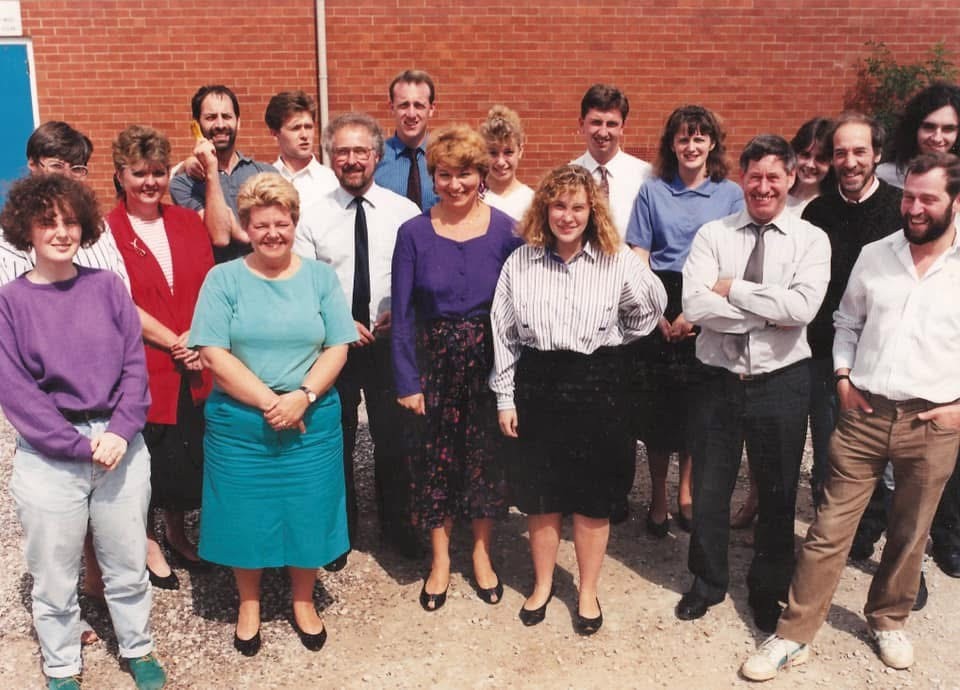
The Publicity and Graphics teams in the early 90s.
A very different workplace
The biggest change Liam and Andy have witnessed is the evolution of technology.
“When I started, there were only two or three computers in the whole sales office,” says Liam. “If a customer called, you could be waiting more than five minutes for someone to finish using one before you could access the information you needed.”
The office environment itself was also very different.
“Smoking in the office was completely normal,” says Liam. “We even had Armitage Shanks ashtrays.”
Andy remembers starting his career on the first floor of the offices, an area known at the time as the Directors’ Floor.
“For a 17-year-old lad, it was quite a scary place to work,” he says. “There were people like Tim Bennett, John Hallett and Granville Cliff based there. When you went into their offices, you could barely see them through the clouds of cigar smoke!”
The workplace hierarchy was also much more formal.
“Directors and senior managers were very separate from everyone else,” says Liam. “They even had their own dining room.”
From scissors and spray mount to digital systems
Many of the biggest changes have come through the introduction of technology.
One of Andy’s early responsibilities was producing the Armitage Shanks price lists.
“This was before computers were the norm,” he explains. “I would cut up sections of old price lists and use spray mount to put everything back together – the original copy and paste.”
Another responsibility was communicating product updates throughout the business.
“Before email, we produced something called a GOBI – a Group Office Branch Instruction. These were printed by the in-house Print Room and around 200 copies would be delivered by hand to the relevant people across the business.”
Communication with colleagues and customers relied heavily on patience.
“There was an intercompany Ping Pong carbon message pad,” says Liam. “You would send a message and it could take three or four days to get a reply.”
Sales representatives were also much harder to contact.
“They didn’t have mobile phones, so they would ring the office from a payphone and get passed around to whoever needed to speak to them,” says Andy.

The Armitage Shanks football team with Andy (back row, third from left), Non-Residential Channel Director Tim Chappell (back row, second from right) and Liam (front row with his hand on the ball).
The people who made the memories
While technology has changed dramatically, both Liam and Andy agree that the people are what stand out most when they look back.
Lunchtime was once a shared experience across the entire business.
“Everyone had the same lunchtime – 12.30pm to 1.30pm – so the business effectively shut down for an hour every day,” says Andy.
Friday lunchtimes were another tradition, with colleagues regularly heading to The Swan or The British Legion.
The business also had a strong sporting community with Liam and Andy both playing for the Armitage Shanks Football Club which was set up in 1989 and was never relegated – or promoted! The team included many familiar faces from the business and played in the Lichfield and District Football League for seven years.
“We never won any trophies,” laughs Andy, “but we had some great times and still tell stories from that era.”
The memories are still kept alive today, with a Facebook page dedicated to the football club and the friendships created through it.

Red Nose Day 2005 in Business Support Office. Back row, left to right: Serena Dockerill, Chris Bennett, Andy Warrington, Phil Hodson, Pete Stevenson. Front row, left to right: Eunice Egan, Nicole Edwards, Michelle Andrews, Charlie O’Brien, Jean Maj, Alison Weatherer
Familiar faces across generations
For many colleagues, the strongest connection with Armitage Shanks has always been the sense that it was more than just a workplace. Both Liam and Andy have seen generations of families become part of the business.
Liam’s father worked in the factory and also drove HGVs. His son Jack completed work experience in Mailing, while his son Harry worked in the Warehouse. His brother-in-law Rob Carter also recently retired after an incredible 44 years in the Refire department. Liam even met his wife Michelle through the business, as she worked in the Sales Office.
Andy’s family connection is equally strong. His parents John and Sue Warrington both worked in the Warehouse, while his sister Jane Beck worked in the offices in Sales for around 28 years before sadly passing away in 2022.
Andy also met his wife Caroline Stead, who worked in the Business Support office for 20 years, in the late 1990s. They have now been together for 26 years and married for 21. Caroline’s parents were also connected with the business, with her mother Linda working in HR and her father Peter spending time in Mailing.
Their daughter Maddie also completed work experience in the laboratories.

Andy with Brian Harvey and Alan Cope.
Remembering the people who shaped the journey
Looking back through old photographs and brochures brings back memories of many colleagues who helped shape the business over the years.
A 1990s brochure, for example, features familiar faces including Steve Parker, Chris Golding, Alison Weatherer, Natalie Kent, Michelle Andrews, Pete Stevenson, Diane Baseley and Kay Barlow.
For colleagues who have shared those years, those names represent much more than a list of employees – they are reminders of friendships, projects and everyday moments that made the business what it was.
Even product codes still bring back memories.
“When you meet people who worked in the office in the 1980s, they often enjoy testing each other,” says Andy. “‘131308S?’ ‘Ova pedestal!’ ‘117923S?’ ‘Portman 500mm basin, two tapholes!’”
Looking back – and looking forward
After more than 40 years, Liam and Andy have experienced extraordinary change, from handwritten paperwork and manual processes to today’s digital, connected and global business.
They have seen factories change, processes become automated and the company evolve from Armitage Shanks into Ideal Standard and then part of the Villeroy & Boch Group.
But the biggest constant has been the people.
For Liam and Andy, their careers represent far more than years of service. They are a reminder of the generations of colleagues who have helped build the business, the friendships formed along the way and the shared memories that continue to connect people across the company.