

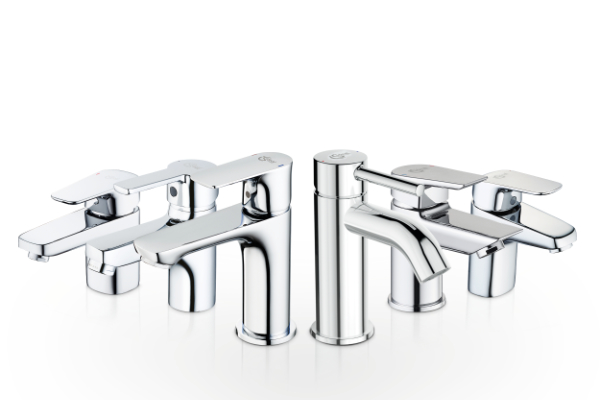
This feature was written for the CIPHE’s P&HE journal for plumbing and heating engineers by Jeff Williams, Category Manager for Fittings at Ideal Standard. As well as forming part of our major campaign to promote our new brassware range, which launched in July, it offers an interesting insight informed by Jeff’s 40 years in the industry.
There is a school of thought that once you’ve seen one tap, you’ve seen them all. To me that’s like suggesting all people are essentially the same, because they are made of the same composite parts. Just like people, every tap has an associated history and the way they’re manufactured can create very different end results.
The millions of Ideal Standard taps which are sold every year are manufactured in either Germany or Bulgaria. Both plants subscribe to our ethos that a tap is only as good as the materials you put in it. Germany’s history for manufacturing excellence is renowned and the site there is famous for producing well engineered products from brass which is delivered to the factory. In Bulgaria we have a unique story. We smelt our own brass ingot from copper and zinc which are delivered to the site daily. The ingot we then create is checked to make sure it meets our internal specification and only when it passes those rigorous tests does it enter the foundry.
 (Above, casting molten brass in the plant in Wittlich, Germany)
Setting the Standard
So how do we decide if the brass is good enough? As a large-scale manufacturer our internal standard for brass is very precise and the way we arrive at this tells an interesting tale. It’s a little-known fact that Germany sets the standard across Europe for the quality of metals which come into contact with drinking water. We cannot and will not run different qualities through the factory, so the output is harmonised to meet Germany’s requirements. This means, because we have a sizeable presence in a number of countries, they all benefit. This is of particular interest to the UK, as at the moment we have no minimum material requirement for brass. In theory, you could make a tap out of a poor grade of brass and you could still achieve WRAS accreditation.
Behind the Scenes
Once we’re happy with the brass ingot, the next step of manufacture is casting. Molten brass is poured into a product specific two-part metal die, or mould, that opens between shots to take out the newly formed casting and replace a core made of silica and resin. This creates the internal coring often referred to as the waterways. To aid this process we use a water-based graphite solution to ensure the core does not stick to the internal wall of the die. The casting is then placed into a huge industrial tumbling machine which loosens and washes out the silica sand core. What’s left is a rough casting ready for the grinding, polishing and plating process.
The grinding is done by a machine and the polishing is then done by hand. At this point the taps are a highly polished golden colour. Once they’ve been polished the inspections begin. Anything which fails at this stage is recycled back into brass.
Then it’s off to be chrome plated. Every tap is washed, prepared, degreased and then dipped in baths of nickel and chrome. Once they’ve been plated a second inspection begins to ensure it meets our robust standards. After the chrome plating comes the assembly, and 100% integrity checks, before finally being packaged up ready to be sent out.
 (Above, another view of the Wittlich plant)
Tap Trends
Hopefully by now it’s clear that the attention to detail and the high standards in our manufacturing process prove that our brassware is a quality product you can rely on. But what about the design? The brassware market is frighteningly competitive with over 70 suppliers to our customer base. All of them have huge portfolios, so we have to create something new to engage people.
In the last 20 years the UK has been dragged kicking and screaming towards adopting a single lever basin mixer as standard. Most new kitchens and bathrooms you go into these days have this kind of tap. It’s also fair to say that tastes in this country are definitely more conservative than those of our European neighbours. People tend to think more radical design is better, but for the UK that’s definitely not the case. We work with industrial designers on our products and at least three or four are briefed when we want something new. Once the design is complete it’s passed to our engineers to industrialise.
Buy Cheap, Buy Twice
It’s true to say you could go out today and buy a cheap tap, which once installed for a customer would do a decent job for a few years. But taps go through a lot on a daily basis. They’re products with many moving parts and lots of local variance. Much of the UK population live in hard water areas which causes all kinds of problems with lime scale deposits, plus there’s the challenge of very differing hot and cold-water pressures to factor in. It’s not as straight forward as you may think.
We play to our strengths, we understand the market and if something does break, we offer a five-year warranty. One of the huge benefits of being a cradle to the grave manufacturer is that there’s always an engineering drawing and there’s always a part.
The bottom line is that an Ideal Standard tap isn’t just another tap; the quality of materials we use and the care we put into our manufacturing processes are what set us apart from the competition.